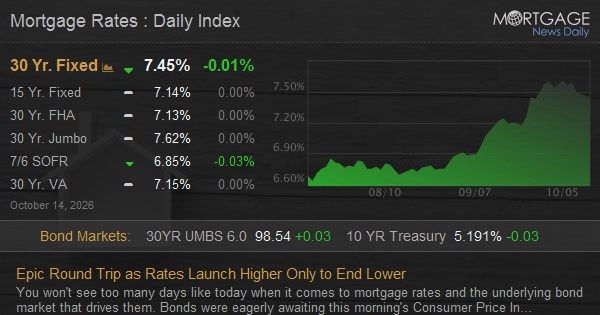
You won't see too many days like today when it comes to mortgage rates and the underlying bond market that drives them. Bonds were eagerly awaiting this morning's Consumer Price Index (CPI), a key inflation report and an important source of guidance for the Fed rate outlook.
Reminder: while the Fed Funds Rate itself does not control mortgage rates, Fed rate EXPECTATIONS tend to correlate much better.
Fed rate expectations leapt higher this morning after inflation came in hotter than expected. The rest of the interest rate world followed in lock step. When lenders released their initial mortgage rates this morning, the daily average 30yr fixed was up 0.1% from yesterday--a very big move for a single day.
But roughly half an hour later, the bond market began gradually moving back in the other direction. The recovery continued at a remarkably steady pace (not the sort of linear pace normally seen on days with sharp reactions to important economic data). The only other thing happening in a similarly linear fashion was the HEAVY selling in stocks.
I'd be the first to point out that it's generally a mistake to assume that a certain development in the stock market reliably predicts an outcome in the bond market. That correlation can be positive or negative depending on the day and the underlying motivations. In today's case, there were solid examples of both positive and negative correlation.
Immediately following the inflation data, stocks and bonds lost ground in unison. We'd reconcile that by saying higher Fed rate expectations spell bad news for both. But then the stock selling continued--ultimately progressing toward the worst day of losses in over 2 months.
Huge moves in the stock market can often get the attention of the bond market--especially if stocks are tanking after recently hitting all-time highs in a market where there is some speculation about the longevity of bullish sentiment (as there is now surrounding the AI buildout). For today's purposes, we don't need to know if stocks ultimately get back on track. We only need to imagine that there was enough selling pressure in stocks to cause a decent chunk of investors to increase allocations in bonds.
Such a turn of events would help explain how bonds got all the way back to positive territory (i.e. good for rates) by the end of the day. Thankfully, mortgage lenders were surprisingly willing to make the appropriate adjustments to their rate offerings. The average lender actually ended the day 0.01% LOWER than yesterday--something that seemed all but impossible at 8:31am ET this morning.
 Follow Mortgage Rate Watch daily in our email newsletter.