After failing on repeated occasions to extend a two-month rally, mortgage rates took the path of least resistance this week: UP
The BestEx levee burst.
In the chart of Consumer Rate Quotes below, if the line is moving up, closing costs are rising. If the line is moving lower, costs are getting cheaper. Sideways mortgage rate behavior followed by an abrupt drop followed by another spell of mostly sideways activity can be seen when looking closely. This spell of sideways activity took place near the most aggressive rate quotes of the year. Since setting new lows last Friday, consumer borrowing costs have risen sharply.
Home loan borrowing costs clearly spiked this week...
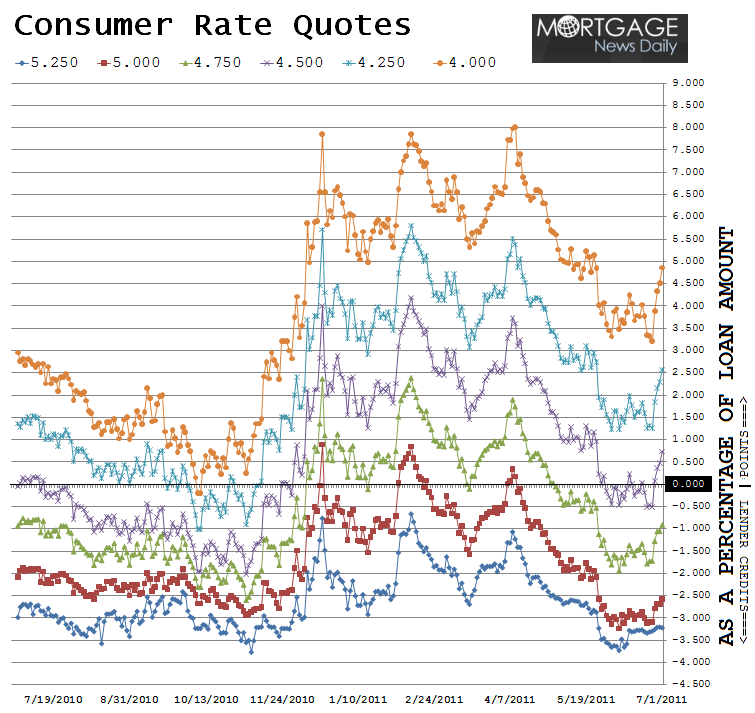
The chart above compares the average origination costs (as a percentage of loan amount) for several available mortgage note rates as quoted by the five major lenders. Each line represents a different 30 year fixed mortgage note rate. The numbers on the right vertical axis are the origination closing costs, as a percentage of your loan amount, that a borrower would be required to pay in order to close on that note rate. If the note rate graph line is below the 0.00% marker, the consumer may potentially receive closing cost help from their lender in the form of a lender credits. If the note rate line is above the 0.00% marker, the consumer should expect to pay additional points at the closing table to cover permanent buydown costs and origination fees. PLEASE SEE OUR MORTGAGE RATE DISCLAIMER BELOW
CURRENT MARKET*: The "Best Execution" conventional 30-year fixed mortgage rate has risen to 4.625%, but fewer lenders are readily quoting it after additional weakness was experienced today. More lenders are offering 4.75% instead (extra margin in rate sheets). On FHA/VA 30 year fixed "Best Execution" is still 4.375% but just barely, 4.50% is more willingly quoted. 15 year fixed conventional loans are best priced at 3.875%. Five year ARMs are still best priced at 3.25% but the ARM market is more stratified and there is more variation in what will be "Best-Execution" depending on your individual scenario.
GUIDANCE OFFERED LAST FRIDAY: This is as good as it's been all year. Since the middle of November really. If you're on a short lock/float timeline (15 days), now is a good time to considering locking. While a few sessions of continued loan pricing rallies could lead to a lower overall note rate offer, we've been here before (recently) and failed to see investors commit to a sustained rally in the bond market. Our long-term outlook still supports the case for lower rates though, however until we see investors display a commitment to rally, we will be reluctant to advise floating in the short-term, especially with volatility only 2-days behind us.
CURRENT GUIDANCE: Last week's guidance nailed it. The path of least resistance is still up for interest rates, at least in the short-term. That puts us in a defensive posture for at least the next 10 to 20 days and creates an uncomfortable lock/float environment. Rate watchers have two choices: 1) lock up and get out now or 2) try to capitalize on a correction. The former is the safe advice. With respect to the latter, there will be ups and downs no matter which direction rates are trending. And in the current environment, those swings can be BIG, as illustrated in the chart above. For the thrill-seekers out there, or the longer-term, more flexible scenarios, we haven't change our outlook for lower rates by the end of the summer. BEWARE: This is guidance is speculative in nature. We don't have a crystal ball, we can't predict the future, we can only share our outlook. Making the following considerations extra important........................
What MUST be considered BEFORE one thinks about capitalizing on a rates rally?
1. WHAT DO YOU NEED? Rates might not rally as much as you
want/need.
2. WHEN DO YOU NEED IT BY? Rates might not rally as fast as you
want/need.
3. HOW DO YOU HANDLE STRESS? Are you ready to make tough
decisions?
----------------------------
"Best Execution" is the most cost efficient combination of note rate offered and points paid at closing. This note rate is determined based on the time it takes to recover the points you paid at closing (discount) vs. the monthly savings of permanently buying down your mortgage rate by 0.125%. When deciding on whether or not to pay points, the borrower must have an idea of how long they intend to keep their mortgage. For more info, ask you originator to explain the findings of their "breakeven analysis" on your permanent rate buy down costs.
*Important Mortgage Rate Disclaimer: The "Best Execution" loan pricing quotes shared above are generally seen as the more aggressive side of the primary mortgage market. Loan originators will only be able to offer these rates on conforming loan amounts to very well-qualified borrowers who have a middle FICO score over 740 and enough equity in their home to qualify for a refinance or a large enough savings to cover their down payment and closing costs. If the terms of your loan trigger any risk-based loan level pricing adjustments (LLPAs), your rate quote will be higher. If you do not fall into the "perfect borrower" category, make sure you ask your loan originator for an explanation of the characteristics that make your loan more expensive. "No point" loan doesn't mean "no cost" loan. The best 30 year fixed conventional/FHA/VA mortgage rates still include closing costs such as: third party fees + title charges + transfer and recording. Don't forget the fiscal frisking that comes along with the underwriting process.
 Follow Mortgage Rate Watch daily in our email newsletter.