Allow me to draw you a picture...
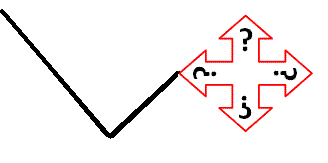
That's a W.
If the top left side of the W represents the economy in December 2007 and the bottom left side of the W represents March 2009, Where do we go from here? Does the Dow retest March lows? Maybe the S&P makes a run at pre-Lehman levels? Or perhaps the NASDAQ will bounce around an unpredictable range as the economy searches for solid footing? I keep rubbing my crystal hoping for some sort of guidance, but all I get back is a cloudy message that looks like "try again later."
In sorting through this question, I try to reconcile daily headline news with long term fundamentals. I ponder what could happen, what is likely to happen, what is not likely to happen, and what I want to happen. When you are doing the same remember how easy it is to get caught up in the market's momentum (either good or bad) and be sure to remind yourself not to let that perception unduly influence your otherwise objective rationalization.
Bagehot, a famous economist in the late 1800's said, "All people are most credulous when they are most happy; and when much money has just been made, when some people are really making it, and when people think they are making it, there is a happy opportunity for ingenious mendacity."
This statement was made well over one hundred years ago so I had to read, and reread, it a few times (and even consult the
dictionary on a few terms) so as to be sure not to misinterpret what Bagehot was attempting to
communicate. His choice of words are very interesting, yet they eloquently capture our
current state of affairs. Lets dissect his choice of wording...
- Credulous - willing to believe or trust without proper or adequate evidence.
- Ingenious - characterized by cleverness, originality or inventive
- Mendacity - a falsehood or tendency to lie
Sound familiar? These words epitomize the rational behind the bad business decisions made by bankers, regulators, and consumers over the past few years. This choice of words personifies a state of mind that is still pervasive in our thoughts and everyday actions. Many believe we've rebounded much too fast, without the support of a solid foundation. Even the market bulls are surprised by the rise in equities since March, many are skeptically waiting for a pullback, a pullback that just doesn't want to happen.
In the process of what many describe as a stock market rally fueled by "irrational exuberance", fixed income traders and short sellers have poured some stiff drinks to cope with the seemingly never ending rally in equities and relentless steepening of the yield curve. In the past this wouldn't have been such a big deal. Unfortunately this time around housing is in a deep recession and the rise in interest rates is offsetting the good deeds done by the Federal Reserve to keep mortgage rates low.
The recent jump in mortgage rates is not welcome in the housing industry, at all. Higher borrowing costs are getting into everyone's pockets: current homeowners, first time home buyers, loan originators, lenders, appraisers, title companies, processors, underwriters, closer...I can keep going. It's starting to get personal. I'm beginning to overhear some of the same dangerous phrases that got us into this mess to begin with: This has to happen....this can't happen....it can't be this bad....it's got to get better.....how bad can it get? Well, we should all know these answers by heart now: no it doesn't, yes it can and pretty damn bad.
Although it's hard to imagine equity indices and debt yields moving higher given current conditions, the following charts help illustrate that the probability of us moving up, is higher than us moving down; at least in the medium to long run.
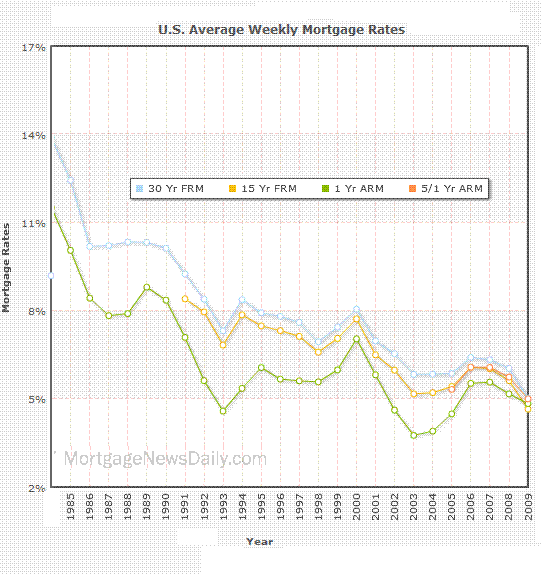
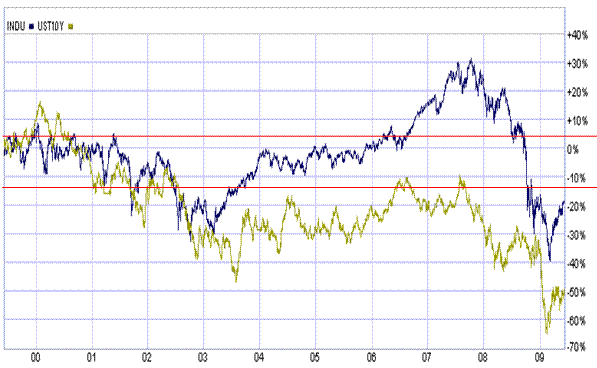
I believe we have a long, tough road ahead once we get over the headline euphoria that the "worst is over" and relalize that "less bad" is no longer good enough. The worst is over but what lies ahead isn't going to be pleasant. Employment and wage growth will likely struggle for several years as firms become more reliant on automation to increase productivity (go back to school). Companies will face an economy operating below potential GDP as aggregate demand lags with employment. The largest contributor to our economies output function, consumer consumption, will be muted as a result. Asset depreciation (especially housing) will continue to stifle long term investment while foreclosures and other loan defaults impair balance sheets across the nation. Robert Schiller (of Case-Schiller) wrote in a NY Times article on Sunday that it's not unreasonable to believe that home values could continue to fall for several more years and reach levels not seen in nearly twenty years. As these and other looses grow, credit will be tougher and more expensive to get.
This may sound pretty bad but whether it's good or bad is irrelevant because the simple fact is, it's necessary. None of this is new, in fact this concept has also been around since the 1800's and was described by Darwin and Wallace as Evolution and Natural Selection.
Unfortunately, more people will become unemployed and many will stay unemployed. However, many will find new careers and others will become entrepreneurs and form new businesses and discover new technologies. Strong companies who are able to adapt to the changing competitive environment will struggle; but will make it and be better off for it. Weak companies, unable to innovate and adapt, will fail, but you can be sure that new ones will be ready to take their place if the competitive space is profitable. Everyone will be better off for it, especially consumers. Over time, we will become more efficient, more productive, and more profitable....capitalism will live on.
As far as I know, no one has a crystal ball that tells them what to do with 100% certainty and success. Our circles of influence are limited and so is our ability to consistently predict the future. Therefore, the question is not whether I think rates will go up or go down, but how will I react to an inevitable movement? As you've heard many times before, how we react to an event is much more important than the event itself. What is your strategy to limit your exposure and risk on an upward rate movement and conversely, what is your strategy to capitalize on a downward movement? Remember, hope is not a strategy and real luck is like lightning, we see it all the time but it seldom ever directly affects us. More often than not, luck is disguised as a meeting between preparation and opportunity.