"BLACK WEDNESDAY". A day when "rate sheet influential" MBS were sold by accounts of all types. Banks, Servicers, Pension Funds, Money Managers, and Hedge Funds...Real Money and Levered Accounts alike. After all was said and done, over $10bn in "current coupon" MBS was dumped by mortgage market participants. An amount not even the Federal Reserve could stand up to...
The broad based shift in coupon bias pushed the MBS current coupon up over 50bps forcing lenders to reprice two, and even three times, consequently increasing mortgage rates into the 5.25% to 5.50% range....the highest levels of the year . This all occurred in one trading session...."Black Wednesday" seems to be a very appropriate designation .
It wasn't just mortgaged-backs that got massacred though. Treasuries took their lumps as well. 10-year yields skyrocketed over 18 bps to almost 3.75%, 2s/10s were steeper by 11 bps to 275 bps, and the 30-year bond rose to 4.65%. Equity investors could not ignore the bloodbath either, the biggest sentiment indicator in the world, the Dow, closed down 173 points after spending most of the morning 200 points higher.
What happened? Why the Broad Based Sell Off in Treasuries and Mortgages?
As Matt eloquently explained in Part I of this Special Report...MBS/Treasury yields spreads were simply too tight (rich). But this has been an event in the making....
Since March 18 the yield on the 10 year Treasury note has increased from 2.54 to 3.75...121 basis points in a little over 2 months.
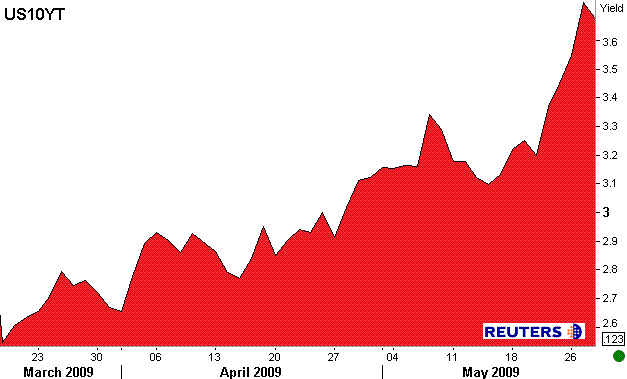
All while the MBS current coupon has held stable near 4.00%. (We call this Par-nertia)
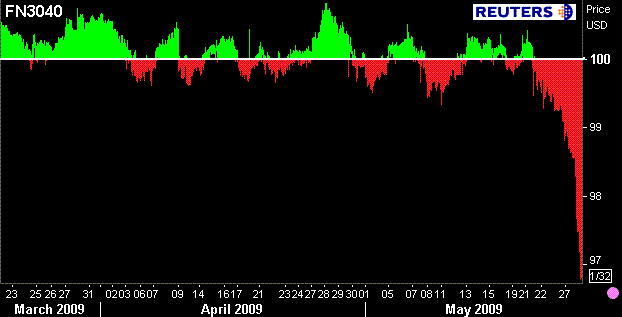
As we have informed, this exhibits the degree to which the Federal Reserve has been "propping up" the mortgage markets. The below chart further illustrates the extent to which the Federal Reserve has intervened in the MBS market in an effort to keep mortgage rates low (all while battling a steepening yield curve). Notice the majority of purchases are in "rate sheet influential" coupons like the FN 4.0 and FN 4.5...
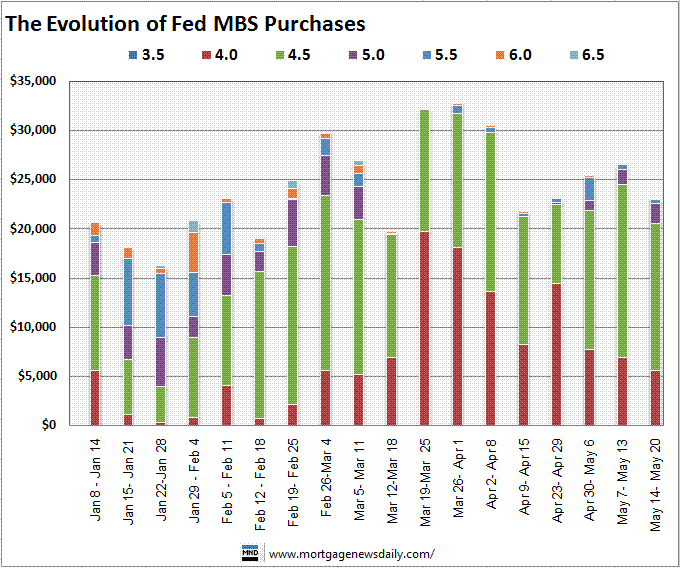
The Fed's buying over the past month has indeed offset a large amount of yield curve steepening. MBS yields have outperformed benchmark Treasury yields.... repetitively....that is until the previously illustrated "tightness" reached a point where the MBS market said "enough is enough". During this period the Fed's intervention in the MBS market sheltered and distorted the value of mortgage related bonds (made them rich) from several fundamentally negative income news events....fundamentals that the remainder of the fixed income market priced into the yield curve.
But What Caused Treasuries and MBS to Collide in Such a Way That Would Cause an Implosion?
Plain and Simple: Duration Shedding and Convexity Hedging. It was all Mortgageland's fault.
If an investor buys "current coupon" MBS and benchmark interest rates move higher...those investors either have to sell those coupons for a much cheaper price (function of negative convexity and embedded call option in MBS) OR that investor must hold the MBS coupon and hope that borrowers find some reason to pay off their mortgage early so those prepaid funds can be reinvested at current market. The latter is unlikely as the borrowers backing those "rate sheet influential" MBS pools will have no reason to refinance if their mortgage rate is below current market (adding duration). These market participants are said to be exposed to a high amount of EXTENSION RISK.
Plain and Simple: If market benchmark interest rates (Treasuries) move higher, non-invested funds then have the opportunity to be invested at current market for a higher yield and more return (dollarwise, not necessarily yield spread wise). If an investor buys MBS and benchmark rates move higher, because the holder of MBS coupon can't call the debt due (only a borrower has call option on their mortgage) that investor will be stuck in an underperforming investment.
Yesterday the MBS market came to grips with the duration of their portfolios...and they decided it was time to shed it. The market had pushed Treasury yields to the point where extension risk was no longer a "could be"...it had become a reality. So holders of "rate sheet influential" MBS coupons dumped it all and repositioned themselves in a manner that would protect their remaining holdings from the possibility of underperforming benchmarks (by shorting similar duration Treasuries and paying fixed in interest rate swap agreements). This hedging (protective) action initiated a broad based selloff in the fixed income marketplace...selling beget more selling as the market realized a "great shift" in sentiment had indeed arrived. It was a snowballing within the snowballing. Yesterday the market was shedding avoid any extension risk related...including longer dated Treasury securities and especially embedded call option securities that exhibit increasing negative convexity as prices move from a premium (over 100-00) into the discount (MBS!).
But Why Now? What Event Caused Such a Broad based (and Brisk) Eye Opening Selloff?
It wasn't one event...it was a snowballing of several events.
The steepening yield curve is the first to blame.
If you're looking for the underlying psychological rationale as to why the yield curve has been steadily steepening (snowballing)....there are several. The ballooning budget deficit combined with recurring record US government debt issuances. The weakening dollar, rising oil prices, and the perception of hyperinflation. The market's perception that the worst is behind us (because of some better than expected economic reports...Consumer Credit? Come on...see housing data) which has lead to investors moving money from risk inverse fixed income assets to higher risk/higher return investments (explosion of corporate bond and new equity issuances). Oh...and there was that message from the "bond king" last week...remember last Thursday when the integrity of the United States' AAA credit rating was called into question? China wouldn't like if we couldn't pay them back...what would the United States do without a financial backer like China? It wasn't just one event...it was a recurring theme of fundamentally bad fixed income news culminating with MBS/TSY yield spreads reaching their "too rich" zone (re events: some of which are bad news for equities too...can you imagine what would happen to the global marketplace if the US credit rating was cut...currency collapse and Armageddon come to mind)
The yield curve steadily steepening since March 18 is something most MBS investors haven't been ignoring though.... as demonstrated by the majority of the MBS market meddling "up in coupon" (6.0 and 6.5 MBS coupons). But a portion of the marketplace had a need, either for balance sheet or charter reasons, to continue to invest in "rate sheet influential" MBS coupons. These MBS investors had been ignoring the short term fundamental reactions of the market because the Federal Reserve was providing enough support to justify holding current coupon MBS.
What those MBS investors didn't count on was a "snowballing" and culmination of fundamentally negative fixed income events...those MBS investors had not priced in the fact that market was now beginning to worry about the "intended" and "unintended" LONG TERM consequences of the US government printing money to stabilize the economy in the short run. Those investors had not priced in the marketplace's nerve to question the long term consequences of a ballooning budget deficit, a weakening US dollar, hyperinflation, and the possibility of the crowding out effect destroying private investment. Those MBS investors were not convinced that the marketplace was ready to flee "risk averse" investments like Treasury bonds and MBS coupons. Those MBS investors were caught off guard by the marketplace's willingness to believe that recovery was in effect.
Plain and Simple: MBS investors were ignoring the short term reactions of "crisis exhausted" market participants. All of these fundamental reactions collided with super rich MBS valuations yesterday (MBS/Treasury yield spreads way too tight) triggering a mass exodus from longer duration MBS coupons (rate sheet influential/current coupon).
Looking Ahead...
As appropriately explained in Part I. Current Coupon MBS spreads can't get much tighter than they already are....this implies we need a rally in the Treasury market (notes specifically) to make room for MBS prices to appreciate and for mortgage rates to fall below 5.00% again. Unfortunately the market's attention will have to be diverted from the previously discussed "intended" and "unintended" long term consequences (back to the slow and steady recovery) before it (the herd) decides to move back into longer dated US Treasury notes.
It appears that only economically bearish news headlines will have the power to push investor's perspectives back into the short term though (like the bankruptcy of General Motors?). Then again the Fed could always step onto their bully pulpit and scare the market away from the "light at the end of the tunnel" (economic recovery)...but even then they must still overcome the fact that the market thinks it is always right.
Wait..isn't the market always right? Allegedly...unless you consider that "crisis exhaustion" (swine flu) has altered the market's perception in such a way that the opinion of right and wrong is skewed (no foundation for good or bad at this point). "Better than expected" has become a means for celebration lately...maybe this "loss of perception" has put the market in a place where rational vs. irrational psychological behavior is no longer discernible. After all, "better than expected" doesn't always mean long term recovery...especially when the relative comparison is record economic weakness. Do you think the market can come to grips with the fact that the Fed is so deeply intertwined in the credit markets (entire banking system) that investors have no choice but to play along with the Fed's every aspiration?
If the market does indeed believe that the worst is behind us...then "better than expected" data releases should only move money if the market's expectations are for noticeable growth and recovery. Either way the market must make up its mind whether or not it is ready to deal with the long term "intended" and "unintended" consequences....if participants are jumping the gun and the economy is only just stabilizing (meaning avoiding a currency collapse and all-out Great Depression)....then upcoming economic data should illustrate this and the yield curve will flatten out allowing mortgage rates to stabilize as the Fed restores liquidity to lenders looking to sell their pipeline of newly originated mortgage loans.
Plain and Simple: The Fed's recent balance sheet expansion has served its purpose...to stabilize the economy in the short run. The calming efforts of the Fed appears to have led the market to believe that the economy is on the road to recovery (V-shaped). If the market perception is distorted and investors are overestimating the timing of such a recovery... the recent steepening of the yield curve will be corrected (oversold) as the herd flows funds back into risk averse assets.
When making an argument for the flip-side...as in the possibility that we are stuck with the 10 year note yield at 3.75 and mortgage rates above 5.0%...one must assume that the economy can escape recession without the help of a housing recovery. NOT POSSIBLE. So we will keep this short and sweet...we do not believe the market is behaving rationally at the moment. There will be a correction. The timing of such a correction depends on the economic data to come and the psychological reactions of market participants.
Plain and Simple: The recent run up in rates and massive MBS sell off was a function of a snowballing of financial market's irrational/"crisis exhausted" reactions to fundamental data. The Fed's interaction in financial markets and whirlwind of contradictory economic data has altered the market's perception of economic reality. We believe the market's perception of recovery is overagressive...what we are witnessing is economic stabilization...the economy has avoided the worst case scenario. Reality must be restored if we are to avoid the market "biting the hand that feeds them" (going against the Fed's policies that are intended to save the banking system), inadvertently pushing the global economy into depression. Now that short term stability has been restored the focus must now be placed on the building blocks of recovery...the biggest of which are restoring jobs (aggregate demand) and rebuilding credit within the banking system. Without this strong economic foundation the housing market will not recover and the United States will lead the world into a global depression.
So yes...Matt and I think mortgage rates will improve in the process. To what extent and when...well that is a crapshoot. Lots more debt to be issued by the US government though....


 MBS Market Alerts


