The Mortgage Bankers Association (MBA) today released its Weekly Mortgage Applications Survey for the week ending November 26th, 2010.
The MBA's loan application survey covers over 50% of all U.S. residential mortgage loan applications taken by retail mortgage bankers, commercial banks, and thrifts. The data gives economists a snapshot view of consumer demand for mortgage loans. In a low mortgage rate environment, a trend of increasing refinance applications implies consumers are seeking out a lower monthly payment. If consumers are able to increase disposable income through refinancing, it can be a positive for the economy as a whole (creates more consumer spending or allows debtors to pay down personal liabilities like credit cards). A falling trend of purchase applications indicates a decline in home buying demand, a negative for the housing industry and the economy as a whole.
Excerpts from the Release....
The Market Composite Index, a measure of mortgage loan application volume, decreased 16.5 percent on a seasonally adjusted basis from one week earlier. This week's results include an adjustment to account for the Thanksgiving holiday. On an unadjusted basis, the Index decreased 34.2 percent compared with the previous week.
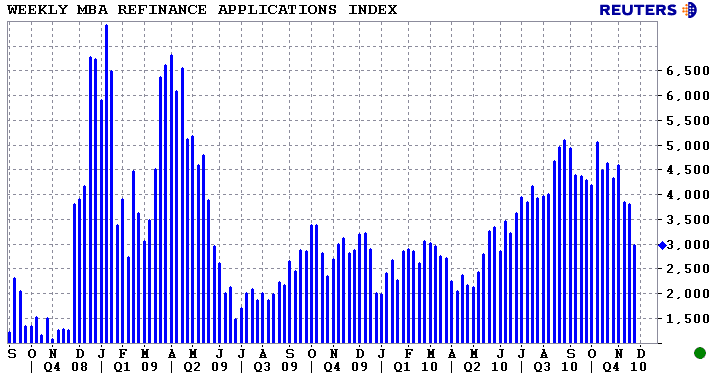
The Refinance Index decreased 21.6 percent from the previous week. This is the third weekly decrease for the Refinance Index which reached its lowest level since June 2010. The four week moving average is down 8.2 percent for the Refinance Index and the refinance share of mortgage activity decreased to 74.9 percent of total applications from 78.6 percent the previous week. This is the third consecutive weekly decrease for refinance share which is at its lowest level since June 2010.
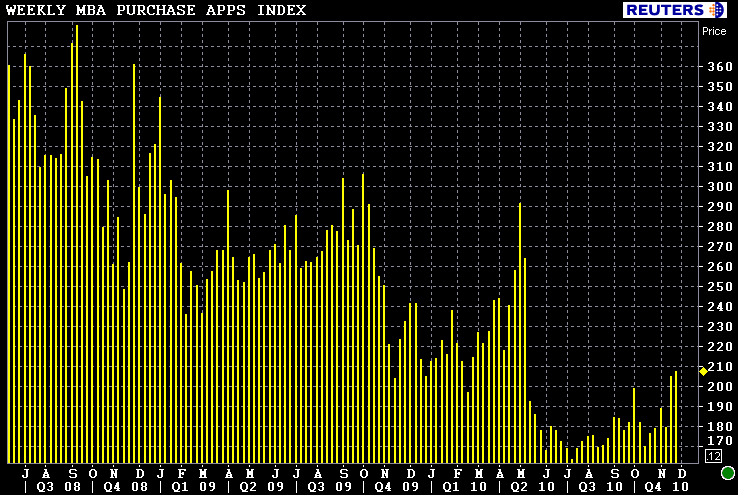
The seasonally adjusted Purchase Index increased 1.1 percent from one week earlier and is at its highest level since the beginning of May 2010. The unadjusted Purchase Index decreased 22.9 percent compared with the previous week and was 2.7 percent higher than the same week one year ago. The four week moving average is up 3.8 percent.
The average contract interest rate for 30-year fixed-rate mortgages increased to 4.56 percent from 4.50 percent, with points increasing to 0.96 from 0.87 (including the origination fee) for 80 percent loan-to-value (LTV) ratio loans. The average contract interest rate increased for the fourth time in five weeks and is at the highest level reported since August 2010. The effective rate also increased from last week.
The average contract interest rate for 15-year fixed-rate mortgages increased to 3.91 percent from 3.83 percent, with points decreasing to 0.88 from 1.04 (including the origination fee) for 80 percent LTV loans. The effective rate also increased from last week.

One has to wonder if rising rates are motivating potential homebuyers off their fences....