As the new administration deliberates on what the government’s role should be in securing mortgage credit across the US, the Mortgage Banker's Association today released its recommendations on how to support the secondary mortgage market. The key recommendation is to create a new type of mortgage backed security that would help to ensure liquidity.
The Mortgage Bankers Association (MBA) said the new security would be supportive of the secondary real estate market for single- and multi-family homes, without putting taxpayer money at risk.
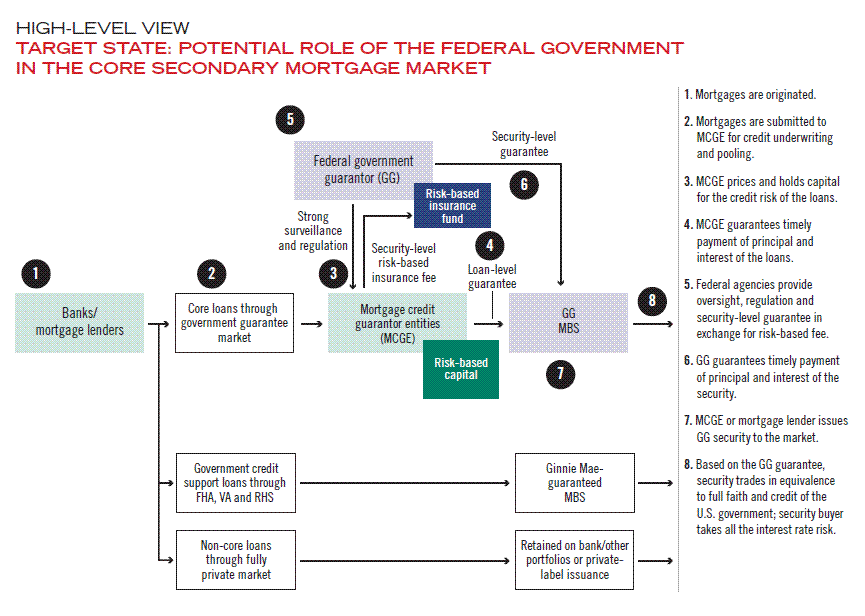
The idea is that a small number of privately-owned, government-chartered and regulated "mortgage credit guarantor entitities" would package loans into securities to be sold to investors (replacing Fannie Mae and Freddie Mac). To keep the securities attractive, risk based premiums would be paid into a federal insurance fund to protect against credit risk.
“Each security would have two components,” a press release explained. “First, a security-level, federal government-guaranteed ‘wrap’ similar to that on a Ginnie Mae security. The government backstop would be explicit and focused on the credit risk of these mortgage securities. Second, the security would be backed by loan-level guarantees provided by privately-owned, government-chartered and regulated mortgage credit guarantor entities (MCGEs).”
The loan-level guarantee would absorb credit losses in the event of a default while the federal insurance fund would only be accessible in “situations of extreme distress.” Thus removing the credit risk from the mortgage security investor while keeping the interest rate risk on their shoulders.
The MBA said the size of the MCGEs would be determined by a mix of competition, efficiency, plus security volume and available liquidity. The strong regulator would ensure that no MCGE could become “too big to fail,” thereby providing another safeguard to taxpayer money.
Private capital backing the security would be held by the MCGEs. Credit risks would be managed by a variety of mechanisms ― including risk-based pricing, originator retention of risk, private mortgage insurance, and risk transfer mechanisms ― to ensure there is a strong capital buffer in the fund.
Any loans not guaranteed by an MCGE would not be included in the security.
The impetus for a new framework comes from the role of Fannie Mae and Freddie Mac in the housing crisis, which “called for a fundamental rethinking of how the government plays its part,” the MBA said.
The group has discussed the idea of a new security with officials from the Treasury, Fannie Mae, and Freddie Mac, and economic advisors from the White House. Yesterday, the MBA also discussed the plan with Federal Reserve Chairman Ben Bernanke and Vice Chairman Donald Kohn. Further discussion will continue today.
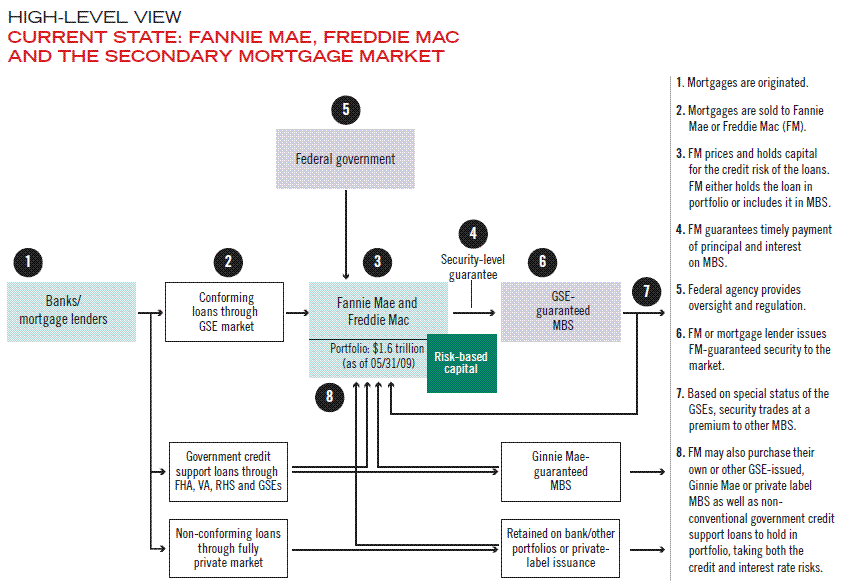
From the MBA release, here is a view of the current framework vs. the proposed framework...