If the results of Fannie Mae's monthly national consumer survey accurately portray their attitudes, Americans appear to have increasingly realistic expectations of the housing market. Data from the June survey indicate that Americans are resigned to lower house prices and higher rents and have come to expect rock bottom interest rates.
The Fannie Mae National Housing Survey polls 1,000 home owners and renters each month to assess their attitudes toward owning and renting a home, mortgage rates, homeownership distress, household finances, and overall consumer confidence then compares the results to answers to the same survey conducted monthly since June 2010.
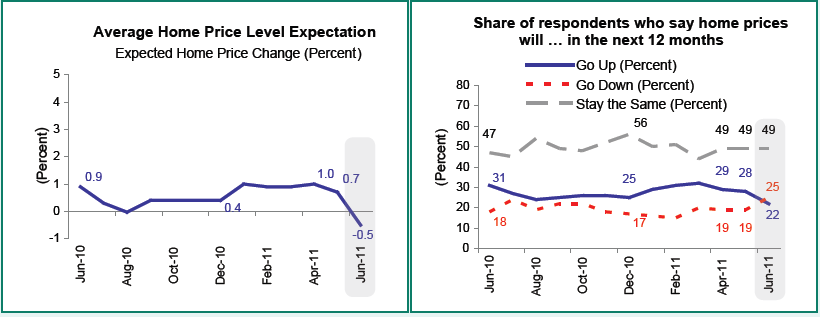
Respondents' expectations regarding home prices have plummeted since the May survey. At that point Americans expected home prices to increase an average of 0.7 percent over the next 12 months. In the June survey the expectation was for a 0.5 percent decline. This is only the second time in the 13 months of the survey that respondents projected a decline in prices. In August the average expected price change was less than -0.01 percent. The number of Americans who expect prices to rise dropped 6 points to 22 percent while there was a 6 point rise in the numbers who expect it to drop, now 25 percent. Forty-nine percent anticipate no change; the identical to May.
Source: Fannie Mae
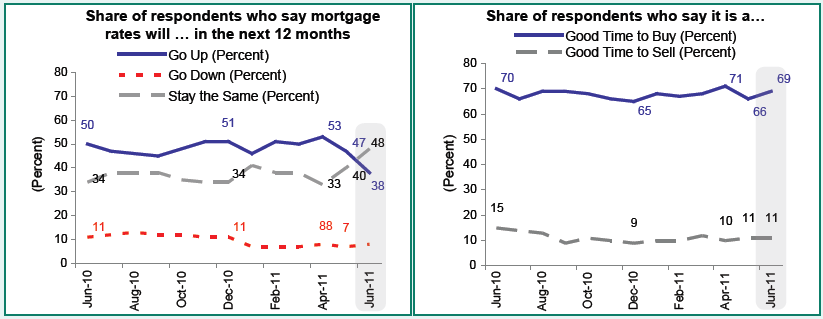
Even though curent market is only slightly above record lows, 48 percent of respondents indicated they expect no change in mortgage rates over the next 12 months, up from 40 percent in May. Eight percent expect further declines while 38 percent think rates will increase compared to 47 percent a month earlier.
Source: Fannie Mae
The percentage of Americans who feel it is a good time to buy a house increased from 66 percent to 69 percent while only 11 percent feel it is a good time to sell, unchanged from May. The good-time-to-buy attitude has varied little over the 13 months the survey has been conducted, ranging from 65 percent to 71 percent. The good-time-to-sell has been relatively more volatile, ranging between 8 to 15 percent.
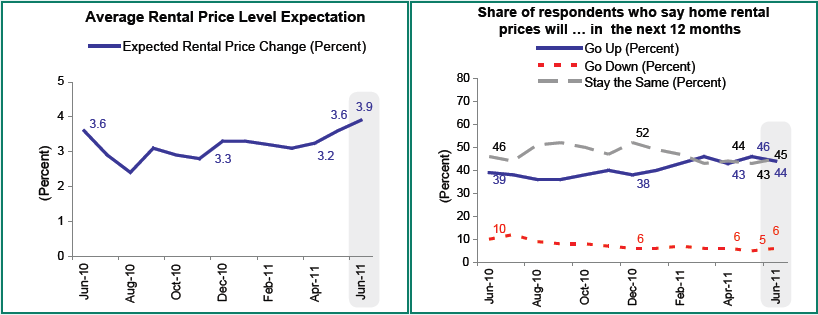
Respondents expect that rents will appreciate an average of 3.9 percent over the next year, up from 3.6 percent in May. Only a smattering of those polled, 6 percent, expect rents to decrease while there is an almost even split - 44 to 45 percent - in those who expect rents to increase vs. those who expect them to stay the same.
Source: Fannie Mae
If they were to move, 66 percent of respondents said they would buy their next residence while 31 percent say they would rent. These numbers are virtually unchanged since May.
In addition to questions on housing, the survey also queried respondents about their personal financial situation. There was a one point increase in those who expect their personal financial situation to worsen over the upcoming 12 months (18 percent) while those who expect their situation to improve or stay the same each declined one point to 38 percent and 43 percent respectively.
20 percent of those surveyed reported their household income is higher than it was 12 years ago, down from 21 percent in May while 16 percent reported it lower compared to 17 percent in May. Sixty-three percent reported no change, up from 61 percent last month.
Household expenses are significantly higher than one year ago according to 37 percent of respondents while 9 percent say they are lower and 53 percent report no change. The corresponding responses in May were 38 percent, 11 percent, and 50 percent. The number of respondents who said their household expenses were higher has declined steadily since March when there was a sudden spike to 46 percent.
In June, the income gap vs. 12 months ago remained the same (+4 percentage points) as in May, while the expense gap increased by one percentage point since May. Compared to March, the expense gap has declined by 10 percentage points.
"Our survey data on key aspects of the housing environment and Americans' household financial situations offer a comprehensive view of the marketplace that hasn't existed previously," said Doug Duncan, Vice President and Chief Economist of Fannie Mae. "There's been strong interest across the industry for a monthly consumer attitudinal data set of this size. The data have only a very short lag from collection to delivery and at present show how sensitive consumers are to contemporaneous events. We see a continued lack of confidence among consumers on home prices, the ability to sell their homes, and the state of their personal finances - all of which point to housing as a continued downside risk to economic growth going forward."
The June survey was conducted between June 1, 2011 and June 28, 2011 via a live telephone interview. Respondents were asked a total of 100 questions to derive the 11 data points reported above.